¡Prepárate para tu examen de Science! 📚
Bones are hard, strong, living organs. They support the body, protect internal organs, and work with muscles to allow movement.
Example: vertebrae
(vértebras)
Example: bones of the skull
(huesos del cráneo)
Example: bones in our limbs
(huesos de las extremidades)
Bones meet at the joints (articulaciones). There are two types of joints:
The bones can move.
Examples: elbow and knee
(codo y rodilla)
The bones do not move.
Example: skull
(cráneo)
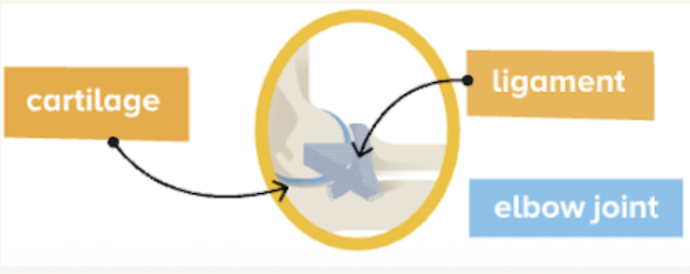
Cartilage (cartílago): In moveable joints, the ends of the bones are covered in cartilage — a tissue that stops the bones rubbing together.
Ligaments (ligamentos): Tissues that hold the bones together at the joint.
Hard, strong, living organ
Covers the ends of bones; stops rubbing
Holds the bones together
Muscles are elastic organs that contract in response to orders from the nervous system (sistema nervioso).
The muscles of the muscular system are called skeletal muscles (músculos esqueléticos).
Many muscles are attached to the bones by tendons (tendones) — bands of strong tissue.
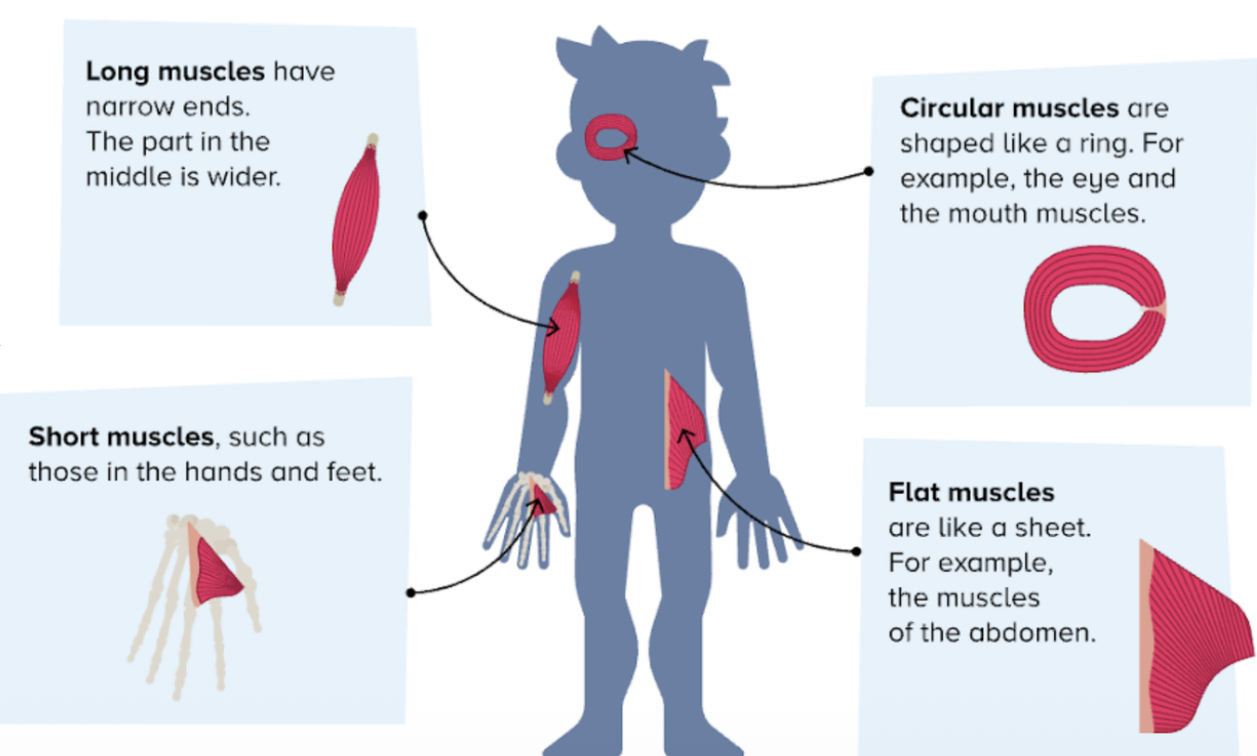
Narrow ends, wider middle
(extremos estrechos, centro ancho)
Such as those in the hands and feet
(como los de las manos y pies)
Shaped like a ring. Examples: eye and mouth muscles
(forma de anillo: ojos y boca)
Like a sheet. Example: muscles of the abdomen
(como una lámina: abdomen)
How can we keep our skeletal and muscular systems healthy?
A broken bone
(hueso roto)
A ligament is stretched
(esguince)
Contraction of a muscle
(contractura muscular)
(ejercicio físico)
(dieta saludable)
(pasar tiempo al aire libre)
Your body functions correctly, no disease, no accidents
(el cuerpo funciona correctamente)
Good relationships, happy with yourself, control your emotions
(buenas relaciones, feliz contigo mismo)
The conditions in which you are born, grow, work, and live
(condiciones en las que naces, creces, trabajas, vives)
| English 🇬🇧 | Español 🇪🇸 |
|---|---|
| health care | atención sanitaria |
| hospital | hospital |
| doctor / physician | médico |
| nurse | enfermero/a |
| pharmacy | farmacia |
| patient | paciente |
| diagnosis | diagnóstico |
| treatment | tratamiento |
The health care system is made up of all the services that provide medical help to people who need it.
(El sistema sanitario está formado por todos los servicios que proporcionan ayuda médica a las personas que lo necesitan.)
It includes doctors, nurses, hospitals, health centres, pharmacies, and emergency services working together to keep us healthy.
In Spain, the health care system is organised into three levels, depending on the type of help you need:
The first place you go when you need medical help. You visit your local health centre and see a general practitioner (GP).
(Atención primaria — cuando necesitas ayuda médica por primera vez, vas al centro de salud y ves al médico de cabecera.)
When you need more tests, specialist treatment, or an operation. Your GP refers you to the hospital.
(Atención hospitalaria — cuando necesitas más pruebas o tratamiento especializado, tu médico te envía al hospital.)
When you need urgent attention right away — for example, a serious accident or sudden illness. You go to the emergency room or call an ambulance.
(Urgencias — cuando necesitas atención urgente de inmediato, por ejemplo un accidente grave o una enfermedad repentina.)
Remember: Always start with primary care unless it is an emergency. Your GP will help you decide if you need hospital care. (Recuerda: empieza siempre por atención primaria, salvo que sea una urgencia.)
| English 🇬🇧 | Español 🇪🇸 |
|---|---|
| disease | enfermedad |
| infection | infección |
| pathogen | patógeno |
| bacteria | bacteria |
| virus | virus |
| fungi | hongos |
| protozoa | protozoos |
| symptom | síntoma |
| sign | signo |
| convalescence | convalecencia |
| allergy | alergia |
Infectious diseases are caused by germs (gérmenes) — tiny living things and viruses, also called pathogens (patógenos). They can be transmitted from one person to another.
Tiny single-celled living things that can multiply quickly inside the body.
(Bacterias — seres vivos unicelulares diminutos que se multiplican rápidamente dentro del cuerpo.)
Very tiny particles that need to enter a living cell to reproduce.
(Virus — partículas muy pequeñas que necesitan entrar en una célula viva para reproducirse.)
Organisms such as moulds and yeasts that can cause infections on the skin or inside the body.
(Hongos — organismos como mohos y levaduras que pueden causar infecciones en la piel o dentro del cuerpo.)
Single-celled organisms that live in water or soil and can cause diseases like malaria.
(Protozoos — organismos unicelulares que viven en el agua o el suelo y pueden causar enfermedades como la malaria.)
Signs of illness that the person feels — for example, pain, tiredness, or nausea.
(Síntomas — señales de enfermedad que la persona siente, por ejemplo dolor, cansancio o náuseas.)
Observable indicators that a medical professional looks for — for example, fever, rash, or itching/irritation.
(Signos — indicadores observables que busca el profesional médico, por ejemplo fiebre, erupción o picor/irritación.)
Germs enter the body through the mouth, nose, skin, or a wound.
(Infección — los gérmenes entran en el cuerpo por la boca, nariz, piel o una herida.)
The person feels ill. The germs are multiplying and the body starts to react.
(Síntomas — la persona se siente enferma. Los gérmenes se multiplican y el cuerpo empieza a reaccionar.)
The defence system is activated, eliminates the germs, and the person recovers.
(Convalecencia — el sistema de defensa se activa, elimina los gérmenes y la persona se recupera.)
Non-infectious diseases are NOT transmitted — they cannot be caught or spread from person to person.
(Las enfermedades no infecciosas NO se transmiten — no se pueden contagiar ni propagar de persona a persona.)
(Accidentes)
(Alergias)
(Mutación celular)
(Dieta)
(Envejecimiento)
(Salud mental)